The cult classic lens
Introduction
In 1975 Vivitar introduced the "Series 1" line of lenses. They were intended to compete
with the best offerings of the major camera manufacturers, albeit at a very high price -- they were quite expensive
even by OEM standards. Nonetheless, discriminating photographers who could afford the price snapped them up and they
are still much sought-after by photographers willing to give up auto focus in return for top quality optics,
construction and versatility.
The most famous of the Series One lenses was the 70-210 macro zoom. One of the first zooms to
offer any kind of macro capability, it offered outstanding optics in a highly versatile package. There were several
versions produced over the years, the first three of which are still very desirable lenses. The last two manual focus
versions are of poorer optical quality and are aren't really comparable to the earlier versions.
After the five versions shown here, Vivitar sold some really poor lenses under the
"Series 1" label, which all but destroyed the prestige of the brand. Any of the autofocus
"Series 1" lenses should be avoided, as should any of the ones that have maximum apertures of f/4.5-5.6.
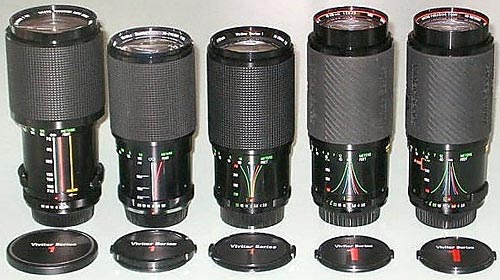
Variants 1-5 (left to right) of the Vivitar Series 1 70-210 Macro Zoom
Image copyright © Frederick Wasti
I started this page almost by accident: I purchased an example of version 3 of the 70-210 Series 1
for a bargain price, planning to sell it at a nice
profit. Then I thought, "Well, let's just take a few shots to see how good
it really is". The resulting photos immediately banished any thoughts of parting with this lens!
Though I eventually acquired examples of the first three versions of this lens, I have since sold all but version 3.
I gathered information about various versions of this lens and put them on a web page as a temporary (or so I thought)
reference for members of the Pentax mailing list.
Before long it was getting so much traffic that I decided to keep it on line permanently.
The 70-210 Series 1 is a great lens for hiking and backpacking. It's light, reasonably fast
and replaces several other lenses, not the least of which is a dedicated macro lens. The 1:2.5 ratio of the Vivitar is
often good enough for flower and plant "macro" photography on trail, and I've recently started using it in
conjunction with an
achromatic (two element) close-up diopter
which yields approximately 1:1 max. reproduction ratio on this lens at 210mm.
I can't fault the Vivitar at all in terms of sharpness.
Bokeh isn't bad but flare resistance, not surprisingly, is nowhere near as good as Pentax. When I have to travel light
I have no hesitation in bringing the Vivitar along, knowing it can produce professionally sharp results.
Below is my ever-evolving, ever-expanding compendium of data on these lenses. I hope you find it useful!
Back to top of page
(Most of my shooting is with Pentax camera gear, so this page generally emphasizes Vivitar lenses produced in the Pentax lens mount,
but anything that isn't specifically labeled as Pentax-specific applies to all mounts.)
Lens Version |

Version 1[1] |
Version 2[1] |
Version 3[2] |
Version 4[3] |
Version 5[4]
(Q-DOS) |
Manufacturer |
| Kiron |
Tokina |
Komine |
Cosina |
Cosina |
Maximum Aperture |
| f/3.5 |
f/3.5 |
f/2.8-4.0 |
f/2.8-4.0 |
f/2.8-4.0 |
"A" Aperture Setting (Pentax-specific) |
| No[1] |
No[1] |
Some[2] |
Yes |
Yes |
Optical Construction |
15 elements
10 groups |
14 elements
10 groups |
14 elements
10 groups |
14 elements
11 groups |
14 elements
11 groups |
Filter Thread |
| 67mm |
62mm |
62mm |
58mm or 62mm[5] |
58mm |
Maximum Magnification Ratio (macro) |
| 1:2.2 |
1:4 |
1:2.5 |
1:2.5 |
1:2.5 |
Weight |
| 879g |
710g |
860g |
670g |
670g |
Note 1: Pentax-specific: Be aware that early versions do not have an "A"
aperture setting and require "green button" stop-down metering with Pentax DSLR's.
Note 2:
Pentax-specific: The presence of the of the "A" setting is one of the things makes version 3 so
desirable today, but Vivitar/Komine only added this feature part way through the production run
so not all version 3 lenses have it: Be sure to check before buying.
Note 3: Version 4 was also made in a hideous
gold plated variation. Optically and
mechanically identical to the standard version 4, but with a finish intended, apparently, to appeal to gangsta
rappers and pimps. It might be worth seeking out if you have the equally ghastly
gold plated Pentax LX. ;-)
Note 4: Version 5, the "Q-DOS" is for 3-D photography (but otherwise
identical to version 4).
See this web site
for more information.
Note 5: The Cosina-made 4th version of this lens was made
with both 58mm and 62mm filter threads. The 62mm version is the more recent and is still sometimes found
new, usually on eBay auctions. Exercise caution if you consider buying one of these lenses without
seeing it: Some sellers would like you to confuse the Cosina (62mm filter) v4 with the much-sought-after version 3 made by Komine.
The less desirable versions of this lens are the ones that have "Vivitar" molded into the focus/zoom grip.
The 58mm and 62mm thread variants of "version 4" may even be entirely different designs. I'm looking into this
possibility and if it proves to be the case it will be added to the table as "version 6". Remember: The first
three versions are the ones sought for their optical quality.
Back to top of page
The general characteristics of the lens versions are the same across all lens mount versions, but new photographers should be aware
of backwards compatibility issues with new, digital cameras and older lenses like these. Keep in mind these general guidelines:
- Pentax: All digital SLR's compatible with all these lenses. Older lenses will require the semi-automated "green button" stop-down metering.
- Nikon: All cameras will permit these lenses to be mounted, but some will not meter at all with them. Generally, it's the high-end, pro (expensive) Nikons that do permit metering. Check your owner's manual for details.
- Canon: Canon changed their lens mount completely in the 1980's — None of these lenses will work on any digital SLR.
- Minolta/Sony: Minolta (now Sony) changed their lens mount completely in the 1980's — None of these lenses will work on any digital SLR.
- Olympus: Olympus changed their lens mount completely for their digital SLR's — None of these lenses will work on any digital SLR.
Adapters
The above information applies to unmodified lenses used without any additional adpaters. There are various lens mount adapters available that will allow you to attach a lens with one mount to a camera body
with another mount. In fact, adapters can be had for m42 screw-mount lenses to fit almost any camera body type.
They almost all require stop-down metering and some cameras bodies won't meter at all with them. Some even limit focusing
range, so that lenses won't focus to infinity.
With enough determination (and willingness to sacrifice image quality/infinity focus/metering) one can theoretically adapt almost
any lens/camera mounts to each other. Many adapters of various types already exist, but because of the sheer number of possible
lens/adapter/camera combinations I am not covering the use of lens mount adapters on this page. Please don't email me about them.
Back to top of page
RESOLUTION (lpm) |
| |
Version 1 |
Version 2 |
Version 3 |
| Aperture |
Center |
Corner |
Center |
Corner |
Center |
Corner |
| |
At 70mm |
| f/2.8 (3.5) |
44 |
35 |
48 |
38 |
49 |
39 |
| f/8 |
62 |
44 |
60 |
48 |
69 |
62 |
| |
At 210mm |
| f/3.5 (4.0) |
39 |
25 |
44 |
35 |
45 |
40 |
| f/8 |
55 |
31 |
55 |
39 |
56 |
45 |
CONTRAST (at 30 lpm) |
| |
Version 1 |
Version 2 |
Version 3 |
| Aperture |
Center |
Corner |
Center |
Corner |
Center |
Corner |
| |
At 70mm |
| f/2.8 (3.5) |
43 |
28 |
55 |
45 |
53 |
25 |
| f/8 |
58 |
32 |
67 |
54 |
70 |
44 |
| |
At 210mm |
| f/3.5 (4.0) |
27 |
16 |
38 |
26 |
58 |
29 |
| f/8 |
52 |
27 |
40 |
34 |
66 |
43 |
Back to top of page
This coding system is for all Vivitar Series 1 lenses, not just the 70-210, but it is only valid for lenses made from the early 1970's up to around 1990.
|
The 1st two digits (or first one digit, in the case of 6 or 9) designate the manufacturer:
|
6 Olympus
9 Cosina
13 Schneider Optik
22 Kino Precision (Kiron)
25 Ozone Optical
28 Komine Co. Ltd
32 Makinon
33 Asanuma (Tokina)
|
37 Tokina
42 Bauer
44 Perkin Elmer (US)
47 Chinon
51 Tokyo Trading
56 Kyoe Schoji
75 Hoya Optical
81 Polar
|
|
The next three digits designate the year and week of manufacture. One digit for the year and two digits (01 through 52) for the week. Obviously, designating the year with a single digit doesn't allow you to differentiate between, say, 1978 and 1988, so you have to infer the decade of manufacture from other evidence (such as when, where and how you acquired the lens, what documentation came with it and the physical appearance of the lens).
|
|
The remaining digits indicate the manufacturing serial number.
|
About once a month someone emails me to say they have a Vivitar Series 1 lens whose serial number
doesn't conform to the above formula. Before you become that person for this month, please re-read the statement above
that says this data is only valid for lenses made between the early 1970's and approximately 1990.
Back to top of page
Click any thumbnail image to see a larger version
There are many other excellent third-party lenses, that is lenses that aren't made by the major camera manufacturers.
An interesting source of information is Robert Monaghan's
"Third Party Lenses Resource Megasite".
Warning: There is so much material on the Third-Party Lens Resource site that you can end up spending several hours browsing your way
through its labyrinthine network of links, but... only if the site is actually online — it frequently disappears for weeks at a time.
Often, even when the site is up, certain pages vanish for no apparent reason, so clicking on any of these links is a little like playing the lottery.
There is an entire section on "cult" lenses, with a page specifically
devoted to Vivitar lenses, but this is one of
the pages that most frequently disappears. I'd put the material on my site, but I haven't been able to reach the author to ask permission.
Back to top of page